As a graduate student pursuing a master’s degree in Professional and Technical Communication at University of North Texas, I am currently enrolled in TECM 5190, a course focused on editing. This week’ s materials challenged me to think more critically about the relationship between editorial consistency, audience expectations, and the decisions that shape effective communication.
When Consistency Meets Context
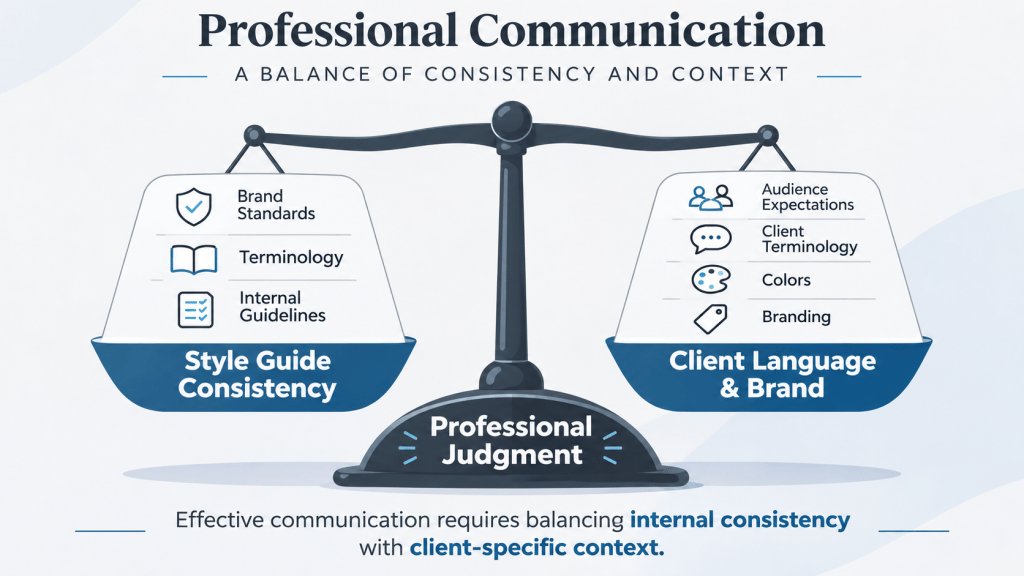
Style guides establish consistency, improve readability, and reinforce credibility. However, one idea that interested me most this week was Professor Kim Sydow Campbell’s emphasis on how style is always contextual. She also discussed the halo effect, through which readers form broader judgments about credibility and competence based on stylistic choices.
This resonated with my experience leading proposal development for large organizations. A proposal’s language, formatting, and visual presentation influence how prospective clients perceive the organization behind it. Even strong solutions can lose credibility when the presentation feels disconnected from the audience.
Our teams followed corporate style guides but frequently adapted proposals to reflect client’s terminology, branding, and visual identity. The question was rarely whether to adapt, but how far those adaptions should go.
One memorable example involved a proposal for a global beverage company that had recently introduced a modified brand identity. The rebranding occurred shortly before our submission, and its reception was still very uncertain. We had to decide whether to incorporate the new visual identity or retain more familiar style and branding. The decision required balancing several considerations: corporate consistency, client recognition, the timing of the change, and how the proposal might be received by evaluators. Ultimately, the challenge was not simply applying a style guide but exercising editorial judgement about which stylistic choices would best connect with the audience.
Language Evolves, and So Must Style
This week’s readings also reinforced how style conventions must adapt to changing circumstances. In Developing a Departmental Style Guide, Jean Hollis Weber emphasizes that style guides should be evolving documents, updated as new questions arise and circumstances change. Her perspective resonated with me because language and societal expectations are constantly evolving, requiring editors to reconsider conventions that may no longer reflect their audiences’ needs.
I have seen that evolution firsthand working in corporate talent. Over time, our job descriptions and proposals increasingly emphasized gender-neutral language. More recently, we became more cautious about automatically inserting broader diversity-related language into proposals, unless the client used that terminology themselves. Shifting societal attitudes and expectations influenced our decisions. The goal was not simply to follow a rule, but to communicate in a way that aligned with the audience’s language and expectations.
Another example illustrating this shift comes from Google’s guidance discouraging words such as simply or easily. Although these words may seem harmless, they unintentionally alienate readers who find a task more challenging than the language suggests.
When AI Saves Time—and When It Costs Time
This week, I further explored Draftsmith, an AI-assisted editing tool, and encountered an unexpected problem while in the final draft stage of a time-sensitive deliverable. After using it to polish a document, portions of the text became scrambled, disrupting sentence structure and introducing errors.
Draftsmith suggested the issue was almost certainly related to my Microsoft Word Track Changes display settings, although Track Changes was not enabled. Outside the assignment, I attempted to recreate the error by experimenting with different settings and testing whether using multiple AI Editing tools contributed to the problem. Despite these efforts, I could not reproduce it. However, the same issue resurfaced during a timed editing exercise, which I will discuss next week.
The experience raised a broader question: At what point does the time spend troubleshooting and correcting AI-generated revisions outweighs the efficiency these tools promise? For now, my recommendation is to preserve the original document for line-by-line comparison and complete formatting changes before introducing AI-assisted copyediting. These precautions provide a baseline for identifying unintended changes and help maintain control over the editing process. I would like to continue to learn more about how to effectively use Draftsmith to determine if it will become one of the tools in my toolbox moving forward. Once I become more competent in the tool, I may conduct a time study to quantify whether AI-assisted editing actually improves productivity.
The Value of Editorial Judgment
This week’s material reinforced that effective editing requires more than applying roles or adopting new technologies. Style guides provide consistency, but audience expectations and evolving language require flexibility, while AI-assisted tools demand careful oversight.
I applied the principles to my structural editing assignment by considering how the organization, clarity, and presentation of information could better serve the intended audience. Moving forward, I will be more intentional about distinguishing necessary corrections from stylistic preferences and evaluating how editorial decisions affect the reader’s experience. I will apply these lessons to my copyediting assignment. I will continue to use Draftsmith throughout my course assignments, but will implement precautionary practices to preserve document integrity, identify unintended changes, and maintain editorial control throughout the revision process.
These lessons also extend into my career in business development and proposal strategy, where producing high-quality client-focused deliverables within tight deadlines is essential. A deeper understanding of style guides will help me balance organizational consistency with client preferences, ensuring communications are both credible and responsive to their intended audiences. Additionally, evaluating and strengthening my experience with AI-assisted editing tools will help me identify opportunities to improve efficiency without compromising the quality or effectiveness of client communications.


Leave a Reply